Another year ticks over. Time to look back on 2006 and look ahead to 2007.
2006 represents a couple of significant personal milestones.
Rochelle and I celebrated ten years in our house. We moved into it, initially as a rental property in August 1996 and a few years later we purchased it. We're proud that we own it debt-free and that we've done many major improvements to it over the years. Many of those changes were masterminded and implemented by Rochelle with the occasional helping hand from me (I'm not nearly as good at DIY home maintenance as she is). Possibly prompted in part by marking a decade in the same home, we're now starting to think about moving up the property ladder; renting out our current home and buying another one. It's depressing to see just how expensive houses are at the moment in Auckland though, and we're not keen on mortaging ourselves to the eyeballs, so at the moment we're just thinking about our options.
I also worked my fifth consecutive year in my current position at Noel Leeming Group, which makes this now the longest time I've spent in the same job, a record previously held by my four-and-a-bit years at Whitcoulls (1995-1999). I started in 2002 and my fifth anniversary comes up at the end of this month. I've held the same position (my official title is 'Internet Site Editor'), since I started, though the actual set of tasks and responsibilities that goes with that position has changed quite a bit over those five years.
The year had its ups and downs - we had a delightful holiday in the South Island early in the year, attending the wedding of our friends Adam and Sandra in Christchurch and then spending a week exploring the South Island by camper van. The trip ended on a sad note however with the news, that reached us while we were travelling through Marlborough, that Rochelle's cousin had died suddenly in a workplace accident.
We took another holiday in October, this time staying in the five star Outrigger resort in Fiji. Again we went for a wedding (of our friends Edwin and Tania), and stayed on for a week. Alas there was less lounging by the poolside sipping cocktails than we'd anticipated due to a few days of terrible weather; but we did make the most of the fine days to visit a small island and to go on a train ride and experience the Fiji Day celebrations. It's alarming to see on the news how the country has rapidly descended into anarchy and martial law in the few months since our holiday though as a consequence of the coup it's now considerably cheaper to take a holiday in Fiji than it was when we visited!
We traded in our old Toyota Celica as the automatic transmission was in need of work, and replaced it with a newer model Toyota Celica (creatures of habit, us!). A protracted battle of wits with the Land Transport Authority ensued over change of ownership when we went to renew the car registration six months later (apparently for half a year we'd been driving around a car that wasn't registered to us!). Fortunately after I stood my ground in the post office and then wrote a sternly worded fax to the LTA this was all resolved out in our favour and penalty fees erased.
Personal highs in 2006 included getting an article I'd written professionally published in the Telos book Talkback: The Seventies and finally seeing my favourite band, U2, perform live in concert for only the second time in my life. In 2007 we're going to see another favourite group, Snow Patrol.
I finished the handover of the TSV editorship to Adam McGechan (we'd shared editorial duties for the last couple of years), and got to sit back and watch as Adam produced his first two issues (the third is underway as I write) with a stonking new design and a strong focus on the new series.
The editorial changeover should have been a positive and re-energising time for TSV and the club but it was overshadowed by a heated argument on the TSV message boards with some readers objecting to all sorts of things to do with TSV and the club. Many months later I'm still not entirely sure that I understand everything behind such a vitriolic outburst. Dissent and discussion is all well and good, but this went further, turning into a personally distressing experience. Adam and I distanced ourselves from the TSV message board for a while after it became apparent that nothing either of us could say would help the situation. I shudder to think what any new visitors to the TSV website during this time would have made of their first impressions of the club.
More positively, the Auckland Chapter started up again in 2006 after a long dormancy and regular monthly pub meetings were held throughout the year in an attempt to emulate UK fandom's legendary Fitzroy tavern meetings. There are similar meetings held in Wellington and Christchurch. At their best, the Auckland meetings have had a good turn-out and I've met a few new faces. The pub meets have also seen the launch of regular issues of Zeus Plug, a wonderful mini-zine deftly edited by Jonathan Park and Peter Adamson. These have been a great talking point at the meetings and I've written a few pieces for various issues. Because it's so very different in both style and focus, I don't think of it as competition for TSV, but I am a little envious at its frequency and the relative ease with which each 16-page, A6 issue comes together!
On a happier note, having Adam take control of TSV left me relatively free to get stuck into my ongoing task of transferring the back catalogue to the Internet with the invaluable assistance of Alden Bates. That man is a powerhouse of web publishing! Eight issues of TSV (covering 1993-94), the Tardis Tales Collection, two 'missing' novelisations and a batch of material which had previously appeared in the Doctor Who Listener Vol.2 was all prepared and published online in 2006. This year I hope to keep up the monthly schedule by covering everything from 1995 and 1996, as well as hopefully the remaining novelisations, a third batch of Listener clippings and also another ebook, this time from outside the TSV stable, a highly sought-after, out-of-print Doctor Who novel (but I'm not saying which one just yet!). Most of these items are already well under way. Stay tuned!

Researching and writing, mainly about Doctor Who
04 January, 2007


28 December, 2006
How I learned to stop worrying and love Doctor Who
Last night we watched The Runaway Bride with a group of friends. No - not that awful Julia Roberts movie, but the brand new Christmas episode of Doctor Who.
I always feel a sense of trepidation and nervous tension when watching a new Doctor Who story for the first time. This doesn't happen with anything else I watch. I’m working my way through the latest episodes of Heroes and Battlestar Galactica at the moment and although they’re both great series, I'm able to relax and enjoy them with no effort.
It's the acute awareness I think that a Doctor Who story's events and revelations need to be absorbed into the series' continuity; what fans sometimes refer to rather ostentatiously as the "canon". Every scene, every line will be picked apart and analysed in great detail in books, magazines and websites ad infinitum. There are books (such as the rather brilliant About Time series) still being published now which take a fresh look at the minutiae of the continuity dating back over 43 years, so you just know that whatever crops up in a brand new episode will be scrutinised for a long time to come.
However there’s a persuasive counter-argument for not doing this, at least on a first time viewing – but rather instead just enjoying the story as a piece of escapist entertainment. Don’t look for the bits that contradict something that happened in an episode that screened thirty years ago. Relax and just enjoy. Sometimes easier said than done.
Many years ago I assisted my good friend Jon Preddle with research for his book Timelink (previously issued by TSV Books and soon to be professionally published by Telos in the UK). Timelink is an awesomely detailed chronology of the Doctor Who TV universe, picking up on the tiniest details presented on-screen to form a theory of a cohesive, single continuity for the series’ entire run. It’s a bit like trying to piece together a vast, incomplete jigsaw and only managing to get some of the pieces to fit by filing down the edges. My task was to watch through the entire set of Jon Pertwee stories making notes on the continuity. Some of my notes were subsequently published in issues of TSV (here, here and here). I was particularly delighted to pinpoint the dating of The Time Monster thanks to an obscure one-line reference. This all took place a few years before The Discontinuity Guide (which took a similar approach to documenting series continuity) appeared; and indeed TSV was acknowledged as a source in that book.
However, having gone through this period of intense scrutiny of Doctor Who, I then found the habit rather hard to break. For a long time I found it difficult to simply watch an episode without mentally checking for references to times, dates and other minor details and how these might link into other stories.
Over the last couple of years watching new episodes of Doctor Who I’ve made a conscious effort to try to be less analytical, at least on a first viewing. I want to get back to a point where I can just enjoy the story without worrying about how The End of the World fits in with The Ark, or what it would take for The Christmas Invasion to exist in the same universe as The Ambassadors of Death.
I think with The Runaway Bride I’ve finally succeeded; last night when watching the story for the first time I managed to sit back, relax and just enjoy the story. I only had one brief slip-up when I caught myself wondering why the hole through to the centre of the Earth hadn’t caused its destruction or indeed yielded any Stahlman’s Gas!!
I always feel a sense of trepidation and nervous tension when watching a new Doctor Who story for the first time. This doesn't happen with anything else I watch. I’m working my way through the latest episodes of Heroes and Battlestar Galactica at the moment and although they’re both great series, I'm able to relax and enjoy them with no effort.
It's the acute awareness I think that a Doctor Who story's events and revelations need to be absorbed into the series' continuity; what fans sometimes refer to rather ostentatiously as the "canon". Every scene, every line will be picked apart and analysed in great detail in books, magazines and websites ad infinitum. There are books (such as the rather brilliant About Time series) still being published now which take a fresh look at the minutiae of the continuity dating back over 43 years, so you just know that whatever crops up in a brand new episode will be scrutinised for a long time to come.
However there’s a persuasive counter-argument for not doing this, at least on a first time viewing – but rather instead just enjoying the story as a piece of escapist entertainment. Don’t look for the bits that contradict something that happened in an episode that screened thirty years ago. Relax and just enjoy. Sometimes easier said than done.
Many years ago I assisted my good friend Jon Preddle with research for his book Timelink (previously issued by TSV Books and soon to be professionally published by Telos in the UK). Timelink is an awesomely detailed chronology of the Doctor Who TV universe, picking up on the tiniest details presented on-screen to form a theory of a cohesive, single continuity for the series’ entire run. It’s a bit like trying to piece together a vast, incomplete jigsaw and only managing to get some of the pieces to fit by filing down the edges. My task was to watch through the entire set of Jon Pertwee stories making notes on the continuity. Some of my notes were subsequently published in issues of TSV (here, here and here). I was particularly delighted to pinpoint the dating of The Time Monster thanks to an obscure one-line reference. This all took place a few years before The Discontinuity Guide (which took a similar approach to documenting series continuity) appeared; and indeed TSV was acknowledged as a source in that book.
However, having gone through this period of intense scrutiny of Doctor Who, I then found the habit rather hard to break. For a long time I found it difficult to simply watch an episode without mentally checking for references to times, dates and other minor details and how these might link into other stories.
Over the last couple of years watching new episodes of Doctor Who I’ve made a conscious effort to try to be less analytical, at least on a first viewing. I want to get back to a point where I can just enjoy the story without worrying about how The End of the World fits in with The Ark, or what it would take for The Christmas Invasion to exist in the same universe as The Ambassadors of Death.
I think with The Runaway Bride I’ve finally succeeded; last night when watching the story for the first time I managed to sit back, relax and just enjoy the story. I only had one brief slip-up when I caught myself wondering why the hole through to the centre of the Earth hadn’t caused its destruction or indeed yielded any Stahlman’s Gas!!
18 December, 2006
Completing the Key

Doctor Who and the Pirate Planet, a novelisation written by David Bishop, is now available online as an ebook.
This adaptation of a television serial by Douglas Adams was one of a handful of Doctor Who TV stories never published by Target Books (I'm talking about the 1963-1989 run here). The omission of The Pirate Planet was particularly irksome to avid Target collectors - and I count myself as one - as it formed part of the six story Key to Time sequence. I still recall as a young and uninformed fan staring at the back of The Armageddon Factor novelisation and wondering why there were only five, not six, books listed in the Key to Time sequence.
The novelisation was first published in 1990 by the New Zealand Doctor who Fan Club. The author was David Bishop, an unknown name in fandom at the time, but now well-known as the author of several Doctor Who novels and Big Finish audios. Seventeen years ago this month, David was hard at work writing the first draft of this book.
I revised and expanded the novelisation for a new edition in 2001, with David's approval, incorporating a large number of sequences from the rehearsal scripts that had been cut from the televised story. For the new ebook edition, I dug out the notes I made in 2001 and attempted to document the changes for a editors' commentary.
After struggling through a few chapters, trying to convert numerous notes into readable prose, I decided that a far simpler solution was to present the deleted scenes from the rehearsal scripts as extracts from the novelisation and leave it at that. This proved to be a fairly straight-forward task, but to my surprise I discovered that I'd omitted a few of those scenes from the 2001 edition, so these segments appear for the first time ever in this ebook.
The ebook is also available as a downloadable PDF file and is accompanied by several 'special features', including an article about the book's publication history, a guide to the 'deleted scenes', a gallery of cover artwork, and David Bishop's notes from the original edition.
30 November, 2006
Loving the Nimon

Published in October 1994, TSV 41 marked the thirtieth anniversary of Doctor Who's first broadcast on New Zealand television (the exact date was 18 September 1964). A set of three articles by myself, Graham Howard and Nigel Windsor examined aspects of this theme. These items have been left out of the online edition. It might seem a little odd to overlook what were effectively the lead articles, but I have my reasons. Nigel's piece speculated on which TV channel might play the series next (it was off air at the time) which is of course now very dated, Graham's article was a research piece about the NZBC archives, since superceded by Jon Preddle's research in recent issues, and my own overview of the history of Doctor Who on New Zealand TV is much better represented by the Another Time and Space e-book. However these omissions don't particularly harm the online edition as there's still a good solid chunk of material from TSV 41 to revisit.
The highlight of the issue is to my mind Phillip J Gray's defence of a much-maligned story in Why the Nimon Should be Our Friends. That article was selected as the sole example of TSV's output in Paul Cornell's Licence Denied fanzine anthology. It's a great article which I think is at least partly responsible for some fans reassessing The Horns of Nimon and also re-evaluating the relative merits of the Graham Williams and John Nathan-Turner eras. Although Phillip was a regular reader he hadn't written very much for TSV up to this point, but TSV 41 saw a sudden surge of contributions from this talented writer. It's likely that the Continuum '94 convention a few months earlier - at which we'd met for a first time and got on very well - was the catalyst for this surge of inspiration and enthusiasm.
Another provider of much of the issue's content was the ever-reliable Jon Preddle, contributing several pieces including a script to screen instalment for Vengeance on Varos, an item about Gallifreyan language complete with Jon's sketches of various on-screen examples of Time Lord script, and also a fairly detailed history of K9. Jon was a god-send when content for TSV was in short supply. I could phone him up and ask for an article on a particular subject and without fail a floppy disk would drop through the mailbox (these were the days before the Internet, of course) with exactly what I'd asked for.
While I was scanning each of the pages for this online edition, I noticed in the 'New Series Rumours' news page a report that Paul McGann had been offered the role of the Doctor but had turned it down. What makes this remarkable was that the TV movie was still a year away from being made, and that at that time McGann would of course finally accept the part.
Tim Hill's cover artwork - featuring many different Cyberman heads (including the proposed Dark Dimension version) - doesn't relate at all to the issue's content, as there's nothing in particular about the Cybermen within. It's no reflection at all on Tim's great drawing, but the issue should perhaps have had a Horns of Nimon themed cover. Coincidentally this was the last of Tim Hill's front cover artwork.
Click here to read TSV 41.
27 November, 2006
The Boys Play Rock and Roll

Hello hello
I'm at a place called Vertigo
It's everything I wish I didn't know
Except you give me something I can feel, feel
The night is full of holes
As bullets rip the sky
Of ink with gold
They twinkle as the
Boys play rock and roll
They know that they can't dance
At least they know...
An entire year has passed since the tickets first went on sale and I’ve just seen U2 live in concert, on Saturday 25 November.
Over the last year, I've felt at times like it just wasn't meant to happen. I originally missed out on tickets for the Saturday show because the website for ordering them crashed, then a week later again missed out on buying tickets for the Friday show over the counter after queuing for four hours. Finally success: a workmate tipped me off about a US-based concert tours company selling NZ U2 fan party packages, so I bought tickets for myself, Rochelle and Jon for the Saturday show. But then U2 postponed the shows for an indefinite period, but we were told to hold on to our tickets. Then the US tour company closed down without letting anyone know, and for a short while before the replacement company contacted me, it looked like we might have lost our money and the tickets. I think I can be forgiven for having just a bit of doubt right up until the show started over whether we were actually going to get to see U2.
Was it worth going through all that difficulty and waiting nearly a year to see my favourite band live in concert? Most definitely!
The show, which lasted two and half hours, was absolutely awesome. We were standing about a third of the way down the field in line with the centre of the stage, so we had great sound, a clear straight-ahead view of the screens and if I stood on tip-toes I could see the band in the flesh. It’s a shame we couldn’t get closer, but it was a sold-out gig and even though we arrived a few hours earlier the field was already half full, so we were fortunate to get as close as we did. Having watched the DVDs of the Vertigo and Elevation tours over and over again (if these had been on VHS I would have worn them out by now), I have to remind myself that it was unrealistic to expect nearly such a good view in person. But what a DVD doesn’t convey is the sheer euphoria of being in the company of thousands upon thousands of people, all cheering and singing along to the songs I know and love.
I'd looked up the set lists from the Australian leg of the tour in advance so I had a fairly good idea of what U2 would play on the night. Even so, there were a few welcome surprises. The band vary the line-up of their middle section and the encores from night to night (partly to keep things fresh, and partly so that the fans who attend every gig get a bit of variety).
U2 kicked off with City of Blinding Lights, a song that feels like it was written as an opening number (“Oh you look so beautiful tonight”); and Vertigo, both off latest album How to Dismantle an Atomic Bomb. Then it was into the audience-participation number, Elevation, which went down very well with the crowd. I was absolutely ecstatic that U2 played Until the End of the World which is a personal favourite and had only been played on a few of the tour dates. I Still Haven’t Found What I'm Looking For was combined to great effect with In A Little While, and Beautiful Day drew a huge response from the audience - especially when Bono sang a verse with New Zealand-specific lyrics, mentioning Cape Reinga and the Fiords seemingly inspired by his tour of the country's scenic spots over the preceding week. Angel of Harlem was next, followed by an acoustic version of Walk On, and then a spectacular version of Sometimes You Can’t Make It On Your Own with Bono giving it his all in an emotionally-charged tribute to his late father. The big surprise for me was the inclusion of Bad, receiving only its second airing on this leg of the tour. Bad is one of those U2 songs that is rather unremarkable as an album track (on The Unforgettable Fire) but electrifyingly comes alive when played live. Then we had Sunday Bloody Sunday, Bullet the Blue Sky (Rochelle's favourite), a haunting version of Miss Sarajevo with Bono impressively covering the Pavarotti bits in fine voice; the ever-popular Pride; Where the Streets Have No Name (which in my opinion has been somewhat watered down from the Elevation tour version), and then to close the main part of the show possibly U2's most popular song ever, the achingly bittersweet One.
But it wasn't over yet. The encore teased with the slot-machine animation (which included some New Zealand-specific images), making me think that we were going to get Zoo Station, but no, instead we had The Fly in all its glory, complete with a bombardment of slogans and catchphrases, recalling the fabulous Zoo TV tour. The Achtung Baby theme continued with Mysterious Ways, and then the first encore ended with an awesome rendition of With or Without You. After a short pause, the band returned to the stage to play the last songs of the night - the new track The Saints are Coming, a rocking version of Desire, and then - last of all - One Tree Hill, which was only performed for the New Zealand concerts. The song ended with the crowd softly singing the last verse back to Bono with no musical accompaniment. In the still night air this was simply magical and an awesome way to round out a fantastic experience. We were truly at a place called Vertigo.
29 October, 2006
This is 40
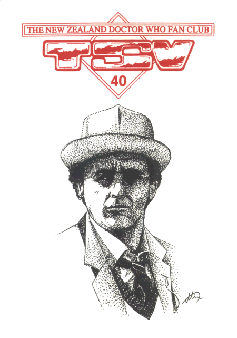
In the TSV online archive project I've finally hit the 40 issue milestone. That issue was published in July 1994, which marked the seventh anniversary of TSV (on average that's very nearly one issue every two months for the first seven years which is pretty good going and quite remarkable considering how few and far between issues have been published in more recent years).
With TSV 40 it seemed like the zine had achieved a greater importance and recognition. This was all due to the interview with Seventh Doctor era script editor Andrew Cartmel.
An Andrew Cartmel interview was at the time one of the holy grails of Doctor Who fandom. Cartmel was regarded as reclusive and mysterious, declining all requests to talk about his time working on the show. What part had he played in shaping the direction of the series and developing Sylvester McCoy's 'Dark Doctor'? What had been prepared for Season 27 and what was the so-called 'Cartmel Master Plan'? These questions remained unanswered as long as Cartmel kept his silence. He'd been interviewd by other publications about his New Adventures novel (Cat's Cradle: Warhead) and his DWM comic strips, but wouldn't discuss his stint as script editor. I think Cartmel had seen the way a section of fandom had treated producer John Nathan-Turner and former script editor Eric Saward, both of whom had given many interviews, and decided that if he remained silent, there was little that anyone could say about him.
Cartmel finally relented, apparently due to the persuasive charms of David Bishop, David hd been trying to get Cartmel to agree to an interview for months. As I recall, David Bishop met Andrew Cartmel through Judge Dredd: The Megazine, which David was editing at the time. That David got the interview where all others had failed was a testament to his persistence, and what was even more remarkable, from my perspective, was that he gave the interview to TSV, free of charge.
David Bishop had moved to the UK in 1990 but never abandoned his support of TSV. David believed in what I was doing and seized on any opportunity that came his way to generate interview material, recognising that it was very hard for a New Zealand fanzine to secure and conduct interviews with UK-based Doctor Who personalties. I am eternally grateful to David for this support, and the Andrew Cartmel interview remains one of the shining jewels in the TSV back catalogue.
The Andrew Cartmel interview occupies over a third of the print version issue, leaving little room for many other features. Some TSV readers said that the interview ought to have been spread over three issues but I was aware that it was likely that DWM or another magazine would respond after seeing the first instalment by either buying up the entire interview or conduct their own and I was therefore worried that this would see print before we had published the remaining parts. Sure enough, within a fortnight of the issue's publication
Doctor Who Magazine editor Gary Russell did indeed snap up the reprint rights, but to Gary's and DWM's credit, they didn't publish the issue until the following year, giving TSV time to gain recognition first - and we did receive a small footnote in DWM acknowledging TSV as the source. DWM bought the interview off David (which made me feel better about not being able to pay him for his efforts - although I did give him a free subscription). The DWM version (published in 1995) was heavily edited and re-worded; the original interview only ever appeared in TSV 40.
In addition to the usual reviews, TSV 40 also featured the return of the popular TARDIS Tales cartoon in a New Adventures-inspired adventure, a study of the Krynoids and a collection of deleted scenes from Ghost Light.
TSV 40 was one of the most heavily illustrated issues published to date, largely due to the prolific Tim Hill, an Auckland fan still in his early teens who was adept at producing artwork very quickly. I briefed him that we needed a lot of artwork for a major feature covering the entire Seventh Doctor era, without letting on that this was an Andrew Cartmel interview to maintain the surprise and prevent any leaks. Tim delivered a stack of artwork very quickly and also drew the front cover, a minimalist design featuring a moody portrait of the Seventh Doctor which I think nicely tied in with the 'dark Doctor' aspect discussed by Andrew Cartmel in his interview. The issue was delayed by a few days due to the cover being initially misprinted with the artwork not centred.
Reaching TSV 40 in the online archive project is also significant because back in January 2002 when I was planning to electronically capture and restore each issue for online publication, I selected this issue as a test case. I scanned all of the text and artwork from cover to cover to see how much work would be involved (although almost all of the text had originally been produced on a computer, the computer files were lost in a hardrive crash in 1998).
Having successfully created a new electronic copy of TSV 40, I then went back to the beginning and began working forward from the first issue. TSV 1 went online in September 2002; four years later, TSV 40 has finally arrived online.
Click here to begin reading TSV 40.
20 October, 2006
TSV 39 - the online edition

TSV issue 39, originally published way back in May 1994, has been dusted off and added to the online archive.
Unlike the issues immediately either side of TSV 39, there wasn't an interview this time around, but instead Kate Orman wrote a second article for TSV about her debut novel The Left-Handed Hummingbird. Kate was around this time a fairly regular contributor; (I reciprocated by sending Kate some material for her own fanzine, Dark Circus).
Graham Howard contributed another of his thoughtful essays, this time about the depiction of violence in Vengeance on Varos. This was to have been paired up with a 'Script to Screen' article featuring deleted scenes from the same story by Jon Preddle, but the Varos instalment of this regular series was delayed (it appeared a couple of issues later), and Remembrance of the Daleks appeared in its stead.
Life on Mars, an article which attempts to reconcile all the references to Mars in Doctor Who, was the first of many articles written by the multi-talented Peter Adamson, who was at this point just starting out in TSV and had yet to carve his niche as TSV's resident cartoonist and artist. In issues to come Peter became a prolific and versatile contributor, delivering huge quantities of artwork and writing, and also sub-editing work by others.
The Missing Adventures novels were just about to launch when this issue was published. I had a very friendly and helpful contact in Virgin Publishing's London office - Export Sales Manager Graham Eames - and he happily sent me whatever he could lay his hands on to help publicise the book ranges in TSV. One of the items I received was a writers guide for The Missing Adventures. I wrote a short article based on this guide, listing the various 'gaps' between TV stories that were available to prospective authors. For the online publication of this article, I've taken the opportunity to add in a retrospective look at which gaps had been used, and pointing out where Virgin hadn't always adhered to their own guidelines.
This issue was published in the fifth anniversary year of the end of the TV series, which was not exactly a cause for any sort of celebration, but the milestone was marked nevertheless with a speculative article about what Season 27 might have been like. In preparing the online version of this issue I discovered Jon Preddle's original version of this article stored away on my computer. It differs quite considerably to what was published, and veers off on all sorts of tangents, even suggesting at one point that the Doctor was from an earlier universe and had travelled to our universe aboard the spaceship from Terminus! It was nothing if not imaginative. Felicity (my then-wife & co-editor), took on the task of substantially re-editing the article and in collaboration with Jon produced a more focused piece. What's even more significant about this article though is that it speculates about the mysteriously reticient Andrew Cartmel's plans for the series; little did we know at the time that we'd be publishing an in-depth interview with the man himself in the following issue!
The front cover features another brilliant piece of artwork by Warwick (Scott) Gray, - his last front cover for TSV - featuring the Seventh Doctor, Ace and Bernice. I recall Warwick protested at the time that he didn't feel comfortable with his artwork getting pride of place on the front covers, but I thought his work was so good it was a shame not to show it off as much as possible.
Click here to begin reading TSV 39.
Subscribe to:
Posts (Atom)